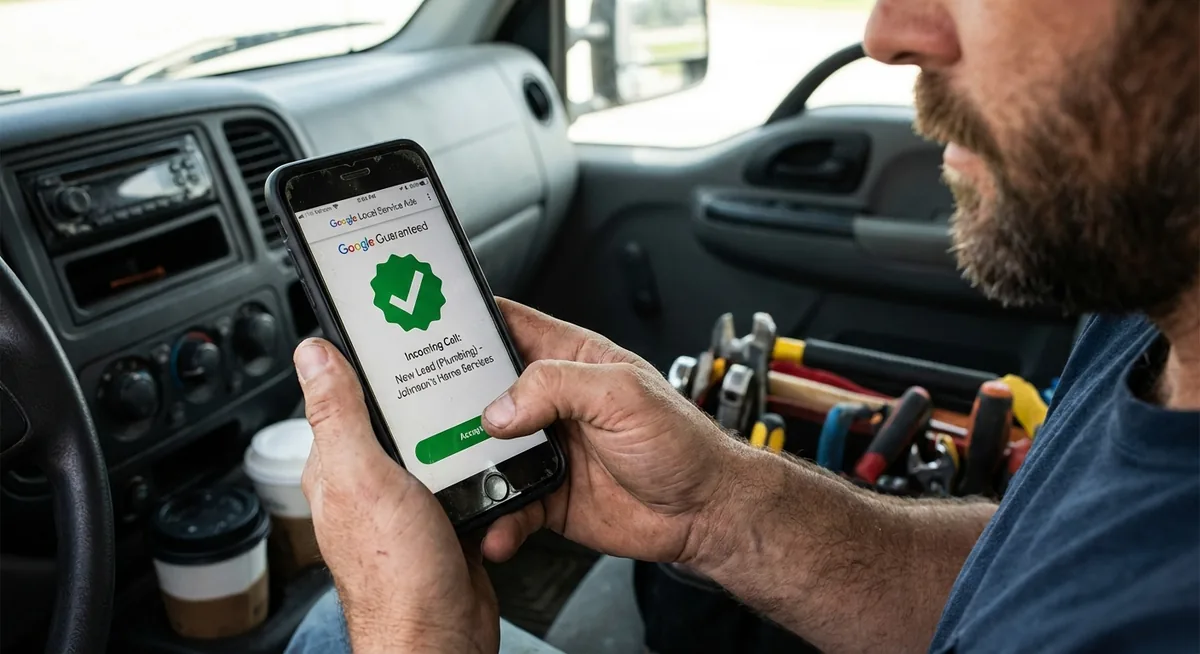
Show up above every other ad on Google — and only pay when a real customer actually calls you. No clicks, no impressions, no wasted budget.
The verification process is a pain — background checks, insurance docs, Google's requirements. We handle all of it so you don't have to.
Your business appears at the very top of Google — above regular ads, above organic results — with your star rating and reviews front and center.
No clicks, no impressions — you get charged when a real person picks up the phone and calls your business. If it's a spam call or a wrong number, Google refunds it.
LSAs aren't for everyone. But if you check these boxes, this might be the simplest way to get leads you've ever tried.
Get Your Market ReportYou're licensed and insured — which means you already meet Google's biggest requirement. Most of your unlicensed competitors can't even get in.
You're tired of complicated dashboards and campaigns you don't understand. LSAs are simple — Google sends you calls, you answer them.
You pick up when the phone rings and you know how to close. LSAs only work if you're ready to take the call — we'll make sure the calls are worth taking.
You're done gambling on clicks. You want to pay for actual phone calls from real customers in your area — and nothing else.
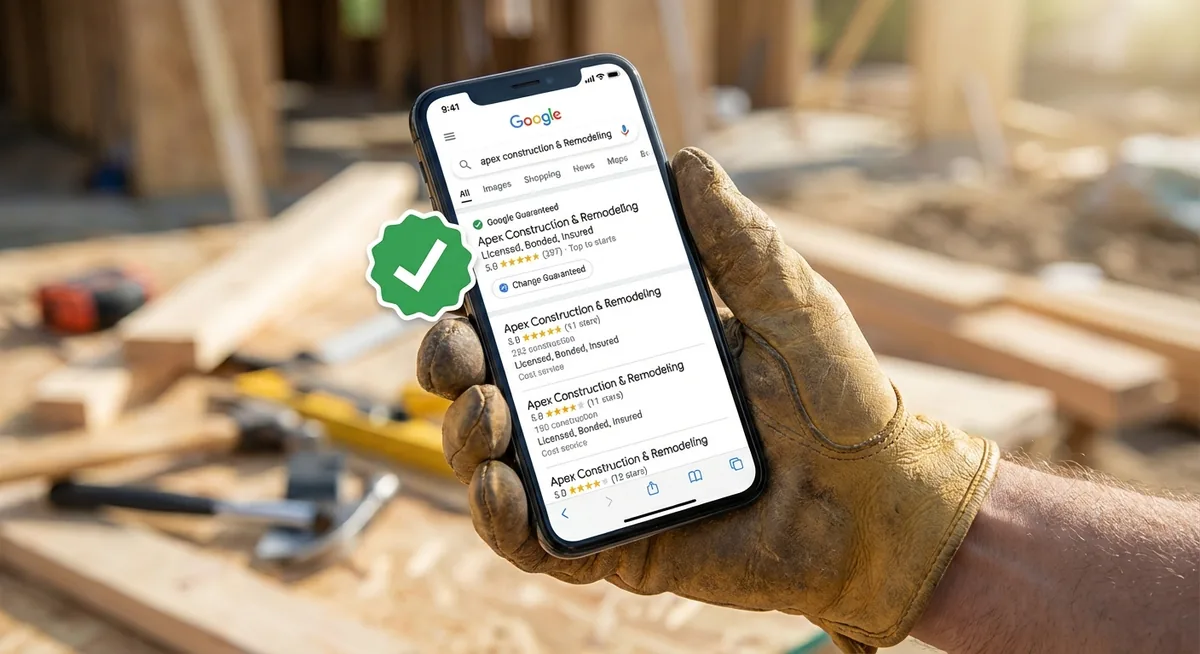
Local Service Ads show up at the very top of Google — above regular ads, above the map, above everything. A customer searches for a service you offer, sees your name, your reviews, and a button to call you right now.
Regular Google Ads charge you every time someone clicks — even if they bounce in two seconds. With LSAs, you only get charged when someone actually picks up the phone and calls your business.
Across the accounts Adapt manages, lead costs range from about $15 to over $300 per call — sometimes for the same trade in different markets. Handyman and garage door calls often come in under $30. Water damage restoration frequently runs $300+ because the jobs are large enough that the math works. Google sets the price based on supply and demand. Adapt helps contractors understand what to expect before they spend a dime.
Once you're verified, Google puts their name behind yours with the Google Guaranteed badge. Customers see it and immediately trust you over competitors without it.
The biggest LSA mistake is setting the budget too low. If calls in the contractor's market cost $80 and the weekly budget is $50, the account generates zero leads and the contractor concludes LSA doesn't work. Adapt's standard recommendation: start at $1,000 per week. In most markets, especially less-competitive ones, contractors spend a fraction of that. But the ceiling is high enough that Google treats the account seriously from day one.
Google decides which contractors get calls based on a simple framework — and once a contractor understands it, the strategy becomes obvious.
Google's real customer is the homeowner searching — and Google wants to send those searches to contractors who have proven, through consistent spend, that they're serious. Accounts that start, stop, and restart rank worse than accounts that run steadily for months.
Google tracks which businesses pick up when customers call. Missed calls, voicemail, and long hold times hurt LSA ranking. Contractors who answer professionally — every time — get more calls over time.
LSA pulls reviews directly from the contractor's Google Business Profile. A business with 8 reviews competing against a business with 200 loses twice: Google ranks them lower, and homeowners see the star count and skip to the competitor.
Market conditions decide most of the outcome. Specifically: how many homeowners in the area are searching for the service, and how many competing contractors are bidding on those calls. Two contractors in identical trades can pay wildly different cost-per-call numbers based on local supply and demand alone. Adapt tracks the accounts it manages to set realistic expectations for every market.
Vague promises don't help contractors make decisions. Here's what LSA actually looks like across the accounts Adapt manages — the wins, the failures, and the math that separates them.
Pays about $15 per lead. Gets multiple calls every day. Same trade, same platform, same badge as a competitor in another market paying five times as much. The only difference: fewer other contractors bidding on garage door calls in their area.
Pays around $80 per lead and receives far fewer calls. Nothing wrong with the account, the reviews, or the response time. The market just has more contractors chasing the same homeowner searches. The market sets the price.
A multi-location handyman business generating over 400 LSA calls per month. Not because handyman work is special on LSA — because they got in early, built a strong Google Business Profile with hundreds of reviews, maintained their account consistently, and operated in markets where not many competitors were doing the same thing.
Water damage restoration calls commonly cost over $300 each. Contractors are willing to pay that because individual restoration jobs are large enough that the unit economics still work. The wrong math for a $500 handyman job, the right math for a $25,000 flood-remediation project.
If a contractor pays $100 per call and closes one out of every 10 calls, that's $1,000 to book a job. For a remodeling company averaging $15,000 per project, that's a strong channel. For a contractor doing $500 repairs, LSA doesn't fit. Cost per lead is a vanity metric. Cost per job, and whether it fits into pricing, is the number that decides if LSA is worth running.
Local Service Ads work best when they're layered into a full marketing system — not treated as a one-size-fits-all lead source. Here's the order Adapt recommends for most contractors starting out.
A real website, an optimized Google Business Profile, and an ongoing review engine. This is the Foundational Marketing System — the stack every Adapt client starts with. Organic leads are higher-quality than paid leads, and the foundation compounds over time without ongoing ad spend.
LSA is the logical first paid channel once the foundation is solid. Low risk, pay-per-call, no wasted spend on clicks that don't convert. It performs best when the contractor already has a competitive review count — which is why it comes after the foundation, not before.
Once LSA volume plateaus and the contractor wants more leads, traditional Google Ads layers on top. More targeting control, higher complexity, higher cost — and worth running only after the first two steps are in place.
Yes — with eyes open. If the Google Business Profile is set up, the review count is reasonable, and the contractor can answer calls promptly, LSA is worth running. The downside is capped by how few calls the market delivers. The upside runs as high as 400+ calls per month. No one can predict the exact result in a specific market without running the account. The point of LSA is to find out what's in the lake by actually fishing. Talk to Adapt about setting up or optimizing a Local Service Ads account.
Google requires verification before you can run Local Service Ads — here's what they need, and what we handle for you.
Your contractor's license, plumbing license, electrical license — whatever trade license your state requires. If you're not sure what you need, we'll figure it out.
Business liability insurance at minimum. If you're already insured, you're already halfway there.
Google requires all LSA businesses to pass a background check. We handle the paperwork.
We submit everything, chase down Google when verification stalls, and deal with the headaches so you don't have to. If you've ever tried to get support from Google, you know why this matters.
Once you're live, we manage everything — adjusting your budget, disputing junk leads, monitoring your cost per call, and making sure every dollar is working. You answer the phone, we handle the rest.
Adapt is a small team that works closely with every client. Tell us what you're working on and we'll figure out the best way to help.
Most home service trades qualify: plumbing, HVAC, electrical, roofing, painting, landscaping, handyman, pest control, garage door, water damage restoration, and many more. Google is constantly expanding the list. Adapt confirms eligibility during setup.
Typically 2 to 4 weeks. Google requires a background check, license verification, and proof of insurance. Adapt manages the entire process — submitting documents, chasing Google when verification stalls, and resolving issues so contractors don't get stuck.
Cost per lead on Google Local Service Ads ranges from about $15 to over $300 — set by supply and demand in each market. Water damage restoration often runs $300+ per call because jobs are large. Handyman and garage door calls can come in under $30. The cost a contractor pays depends on trade and competitor density, not Adapt or the contractor.
Adapt recommends starting at $1,000 per week. In less-competitive markets, most of that budget goes unused — contractors only pay when calls come in. But a low starting budget ($50 to $100 per week) is the biggest mistake contractors make: if calls in the market cost $80 each, a $50 weekly budget won't generate a single lead, and the contractor concludes LSA doesn't work.
No — cost per job matters more. If a contractor pays $100 per call and it takes 10 calls to close one job, that's $1,000 to acquire a customer. For a $15,000 remodeling project, the math works. For a $500 handyman job, it does not. Price marketing cost into each job and the customer effectively pays for the lead.
Yes — LSA uses the contractor's Google Business Profile reviews. A business with 8 reviews competing against one with 200 will rank lower in LSA and get fewer clicks. Reviews also influence whether a customer actually calls after seeing the ad. Adapt treats review generation as part of the LSA strategy, not a separate project.
Yes. Spam calls, wrong numbers, and out-of-scope requests can be disputed for a refund. As of recent Google updates, disputes are processed automatically by AI and are approved about 90 percent of the time in Adapt's accounts. Adapt reviews and disputes junk leads on behalf of every managed account.
Yes. Google allows contractors to run LSA directly. Most contractors find the ongoing management — adjusting budgets, disputing junk leads, monitoring call quality, optimizing the Google Business Profile, and chasing Google support during verification — takes more time than the savings are worth. Adapt manages LSA so contractors can focus on answering calls and closing jobs.
Adapt recommends a three-step order: first, build the foundation — website, Google Business Profile, and ongoing reviews. Second, launch Local Service Ads as the primary paid channel, since LSA is low-risk and leverages the review foundation. Third, layer traditional Google Ads on top when the contractor is ready to push volume beyond what LSA delivers.