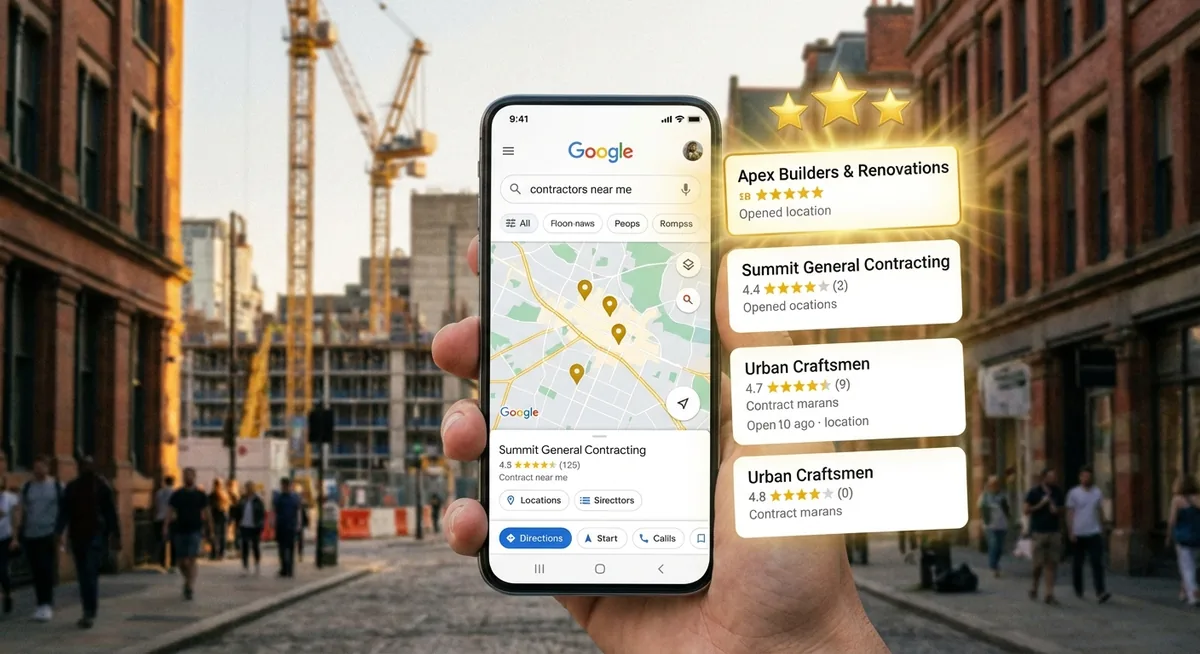
I get asked this all the time — from contractors just starting out, from guys who've been in the trades for twenty years but are tired of the feast-or-famine cycle, from people who've tried everything and still can't figure out why the phone isn't ringing consistently. How do contractors actually find jobs?
The short answer is: Google Maps. But there's a lot more to it than that, and the "how" matters as much as the "what." Let me break down the whole picture — what works, what doesn't, and why so many contractors are leaving money on the table.
Google Maps Is the Number One Way Contractors Find Work
I want to be direct about this before anything else: if you're not on Google Maps and showing up prominently in your local area, you are losing customers every single day to competitors who are. This isn't debatable anymore. It's just true.
Google Maps is a proximity search engine. That means when someone types "remodeling contractor near me" or "electrician Coeur d'Alene," Google doesn't show them the most famous contractor in the country — it shows them the most relevant one nearby. That's the great equalizer. A small local company can completely dominate their market on Google Maps even if they can't touch the national players in organic search results.
I work with a remodeling company in the middle of Chicago. Their Google Maps footprint is maybe a two or three mile radius around their location — that's it. But they stay completely booked out, because within that radius, they're the obvious choice. Does their name come up if you type "remodeling contractor Chicago" in a broad search? Probably not. But they don't need it to. Their neighborhood keeps them as busy as they want to be.
That's the power of Google Maps for a contractor. You don't need to conquer the whole market. You just need to own your backyard.
Google Maps vs. Organic SEO — Which Should You Focus On?
Both matter, but if you have to pick one to focus on, it's Google Maps. Here's why: if you're doing well on Google Maps, you're almost certainly doing well on organic SEO anyway. They feed each other. The same things that help you rank on Maps — a complete profile, consistent NAP (name, address, phone) across the web, good reviews, and a solid website — also push you up in organic search.
The exception is highly competitive urban markets. If you're in a city with hundreds of competitors all fighting for the same keywords, you might struggle to show up in organic search while still doing perfectly fine on Maps. And for most contractors, that's okay. The Maps pack — those three businesses that show up with the pins in a Google search — is where customers are clicking anyway.
Organic SEO is the long game. It's worth building. But don't wait until you've cracked organic SEO before you work on Maps. Start with Maps, build your reviews, and let the organic results come up naturally alongside it.
How Long Does It Actually Take to Rank on Google Maps?
This is the question I get constantly, and the honest answer is: it depends. But let me give you something more useful than that.
There are basically three situations:
You've been in business a while and Google already knows you exist. In this case, just optimizing your profile and getting your reviews up can move the needle fast. When I optimized our own company's Google Maps presence, we saw results very quickly because Google already had trust in us. We'd been around long enough that Google knew who we were — we just weren't telling it what we wanted it to know about us. Fix that, and you can rank almost overnight.
You're a newer company in a market with weak competition. Same story — optimization kicks in fast. If you're in a smaller town or a trade without a ton of established players, getting things dialed in can get you showing up prominently within weeks.
You're brand new and you're up against established competitors with years of reviews and authority. That's the hard road. You're looking at three to six months before you start showing up prominently in Maps. Maybe longer depending on the market. I'm not going to sugarcoat it. You're essentially asking Google to trust a company it's never heard of over companies it's been watching perform for years. You have to earn that trust.
The variable across all three situations is competition. I can look at a market and a company's profile and give you a pretty good estimate. But there's no magic shortcut — you build authority by doing the right things consistently over time.
The Real Story on Lead Resellers Like Angi and HomeAdvisor
I've told this story a hundred times, but it's worth telling again because I still talk to contractors who are considering these services without fully understanding what they're getting into.
A painter named Hemmert Painting came to us wanting to get off HomeAdvisor. He was spending $1,800 a month and wasn't even breaking even. Before HomeAdvisor became Angi Leads, this was his main — really his only — lead source. He didn't like it, but he felt stuck because it was all he had.
We built him what we call our Foundational Marketing System: a professional website, SEO, Google Maps optimization. Within a couple months, he was getting enough organic leads that he canceled Angi completely. Not only did the lead volume hold up — the quality was dramatically better. The people finding him on Google were actually looking for a painter, not just clicking something by accident. To my knowledge, he's still riding that organic train and hasn't done any other paid marketing since.
That's the story I see over and over. But here's the other side of it, because I try to be honest about this:
About four or five years ago, I did an audit and consultation with a contractor who wanted to move off Angi Leads. We sat down and crunched the numbers. Turned out they were getting a six-to-one return — put in a hundred dollars, get six hundred back. When we laid that out on paper, their eyes got big, they said thanks, and walked out. I never talked to them again. They should absolutely have kept using Angi Leads.
The rule is simple: if it's working, do more of it. If it's not working, stop. The only way to know which one you're in is to actually crunch the numbers. How much are you spending? How many leads are converting? What's your average job value? What's the true profit after your time and cost to process those leads? If the numbers pencil out, keep going. If they don't, stop and build something better.
Where I have a real problem with lead resellers is when contractors use them as a crutch and never build anything they own. These platforms can raise their prices tomorrow, change their policies, or go under. You have zero control. And in 2026, there's no reason you can't build a Google presence that generates leads you actually own — leads that come to you specifically because they want you, not because they filled out a form and got distributed to five other contractors simultaneously.
Why Lead Resellers Are Fading Out
Here's the honest reason they still exist: they're big enough to outspend everyone on marketing, and they have a massive sales engine that keeps turning and burning new contractors. That's their business model. They're not in the lead business — they're in the contractor acquisition business. You are their product, not their customer.
They've tried to rebrand. They've changed pricing models. HomeAdvisor became Angi. But I still hear the same complaints I've heard for ten years. The product hasn't fundamentally changed because they can't change it — the reason they were relevant in the first place was that Google wasn't set up the way it is now, and most contractors hadn't figured out how to get online. Back in the early 2000s, HomeAdvisor was genuinely valuable. We used it for years at Kyle Construction and it worked great.
But now everybody has a website. Anybody can get on Google Maps. You can run Local Service Ads and buy calls directly from Google without a middleman. We just don't need lead resellers the way we used to. The only reason to use them now is if your specific situation — your market, your trade, your numbers — makes them profitable. For most contractors, it doesn't.
Reviews: The One Thing That Changes Everything
If I had to pick one thing that matters most for Google Maps ranking and for converting the people who find you into actual customers, it's reviews. Not links. Not keyword density. Not how much you spent on your website. Reviews.
Here's how I think about it: make getting reviews your absolute top priority. Not because reviews are the only thing, but because if reviews are your top priority, everything else has to fall into place. You can't get reviews if you're not getting customers. You can't get reviews if you're not making customers happy. So focusing on reviews forces you to run a better business end-to-end.
Now, the system. Most contractors make a critical mistake: they bring up the review at the end of the job, completely out of nowhere. You show up on the last day, do the final walkthrough, and then awkwardly mention that a review would be great. The homeowner says sure and then never does it because it wasn't part of their mental model of how this was going to go.
Here's what actually works: start the conversation about reviews at the very beginning. On the first phone call, when you're scheduling the estimate, say something like: "Hey, we work really hard to earn a review on every single project — we ask every client to leave us a Google review when we're done. Can I count on you for that?" Get their agreement upfront.
Then reinforce it. First day of the job: "We're going to keep everything clean, do the job right, and on that last day we'll do a walkthrough together and grab that review. Sound good?" By the time you're done, it's not a request — it's an expectation that was set from day one. Everyone knew it was coming. There's no awkward moment, no one feeling put on the spot. It's just part of doing business with you, the same way paying the invoice is part of doing business with you.
Do it this way and you'll get the review almost every single time. It doesn't have to be weird. It doesn't have to feel salesy. It just has to be systematic.
The Referral Flywheel — and How to Actually Make It Spin
Word of mouth is real, but most contractors leave most of it on the table. Here's a simple way to think about it.
Picture two contractors who each do 100 jobs for 100 different clients. Contractor A does great work, treats people well, and occasionally gets referrals. Contractor B does the exact same quality of work, but after every job he asks for a review and hands out a few referral cards.
The referral cards say something like: $250 for you, $250 for a friend. Contractor B's customer hands a card to a neighbor or family member who needs similar work. That person gets a $250 discount when their job is done. Contractor B's original customer gets $250 as a thank-you when the job closes. Nobody loses — and Contractor B just turned one satisfied customer into a referral engine.
After 100 jobs, let's say Contractor A gets 10 referrals. Contractor B, because he's been systematic about asking and has made it easy for customers to send people his way, gets 20. He also has 100+ Google reviews at this point, so every new lead who hears about him and Googles him immediately trusts him. Which contractor do you want to be?
This isn't complicated. It's not salesy. If you feel weird asking for a referral, that's a mindset thing — you're providing real value to people and it's perfectly reasonable to ask them to help you grow. If you do the job right, customers are usually happy to refer you. They just need a nudge and a clear way to do it.
The Biggest Mistake Contractors Make Online
I've thought about this a lot, and I think the number one mistake is this: contractors don't realize that marketing is a competition.
It sounds obvious when you say it out loud. But the way most contractors actually behave, you'd think they believe the Internet is a magic money machine where you put something in and leads come out. They throw $500 at Google Ads and wonder why they're not getting customers. They build a website over the weekend and wait for it to start ringing.
Here's what's actually happening. The second you put your website online, it exists alongside every other contractor website in your local market. Some of those competitors have been online for twenty years. They've invested tens of thousands in SEO, they have hundreds of reviews, they've been running ads for years. In the eyes of Google — and in the eyes of your potential customers — they are serious players.
So when you show up with a website you built yourself last weekend, why should a customer choose you over them? That's not a rhetorical question — it's a genuine one you need to answer. If you were the customer, and you went to Google and typed in your service, would you even find your company? And if you did, would you choose it?
If the answer to either of those is no, you have work to do. Because that's the test. Not "did I put a website up." Not "did I run some ads." The test is: if I were my own customer, would I find my company and choose it over the competition?
The contractors who win figure this out early. They treat their online presence like a sport — study the competition, invest in getting better, and don't expect to walk into a game they've never practiced for and beat people who've been playing for years. It takes time, it takes strategy, and it takes actually committing to the process.
If You're Starting From Zero
Same first step I gave you in the last article, and I'm going to keep saying it because it's true: get your Google Business Profile set up today. Free, fast, non-negotiable. It's the foundation everything else is built on.
Once it's live, make getting reviews your immediate, top priority. Ask every customer. Use the system I described above — set the expectation upfront, reinforce it through the job, make it a natural close. Don't stop until you've got enough reviews that you look legitimate to any stranger who searches for you.
From there, the map becomes clear: optimize your profile, build a real website, work on your Maps presence consistently, and layer in other channels as you grow. But none of it matters if you're not showing up and you don't have reviews. Start there.
The Short Version
Here's how contractors find jobs in 2026, in plain terms:
- Google Maps — your single most important lead source. Build it, optimize it, stack it with reviews.
- Organic SEO — comes naturally alongside Maps. Worth building, but not your first priority.
- Reviews — set the expectation on the first call. Make it part of every job close.
- Referrals — give people a reason and a mechanism to refer you. Referral cards work.
- Lead resellers — only if the numbers actually pencil out for your specific situation. Don't use them as a crutch.
- Paid ads — add them once your organic foundation is in place, not before.
That's the whole system. It's not magic. It's just competing — consistently, strategically, and with enough patience to let it work. The contractors who do these things win their local market. The ones who skip steps or expect overnight results stay stuck.
If you want to know where you actually stand — how your Google presence looks, what your competition looks like, what it would take to rank above them — grab a free market report using the link in the sidebar. We'll show you the real picture, no fluff.